AUDIOGUIDE
1. Holy Trinity Square
2. South Side
3. Statue of King St. Stephen I
4. Matthias coat of arms
5. Nave
12. Saint Stephen Chapel
13. The royal oratory
14. The Chapel of Malta
15. Gate of the Virgin Mary
5. Nave
6. Sanctuary
7. Vestibule
8. The Loreto Chapel
9. Saint Emeric Chapel
10. Holy Trinity Chapel
11. Saint Ladislaus Chapel
12. Saint Stephen Chapel
15. Gate of the Virgin Mary
13. The royal oratory
14. The Chapel of Malta
1. Holy Trinity Square
Dear Visitor, Welcome to the parvis in front of the Church of the Assumption of the Buda Castle, or as is more commonly known, Matthias Church. In itself the very fact that the church has such a complex, dual name is an indication of the colorful, almost eight-hundred-year-long history of the building. Let’s start our tour by taking a look at what these names mean.
The Budapest of today was once two separate cities lying on the two banks of the Danube. Buda, the seat of kings of yore, lay on this side, with Pest on the other. The city of Buda originally lay on flat land, but when the Mongol hordes attacked Europe in the 1200s, they pillaged Buda along with many other Hungarian settlements. After the country was liberated, King Béla IV decided to establish the new city on a rocky outcrop that could be easily defended. This came to be known as Budavár—meaning Buda Castle—which is where we are now.
That is why the church is called Budavár Church in Hungarian to this day, since, just like in all cities, churches were built in Buda as well. Catholic churches always have patron saints: this one is dedicated to the Virgin Mary, the mother of Jesus. The Hungarian name of the church, Nagyboldogasszony, denotes the assumption of Mary into heaven.
The full Hungarian name also includes the term parish church, which indicates that the building was built not for the use of any monastic order or ruler but for the city’s inhabitants. To this day, Matthias Church is more than just a tourist attraction: its primary function is to serve the area’s worshippers.
That is the explanation of the long name of Church of the Assumption of the Buda Castle. Then why does everyone call it Matthias Church?
The original Church of Mary built in the 1240s underwent countless changes over the course of the centuries. One such reconstruction became necessary when the south tower collapsed during Holy Mass in 1384. The entire church ended up being rebuilt, with the new tower completed almost a full century later, in 1470. At the time, Hungary was ruled by King Matthias, who remains one of the favorite monarchs of Hungarians, with his name preserved in many tales and legends. When the tower was completed, the King placed his coat of arms on it. The tower in turn was named Matthias Tower, and later the name was used to refer to the entire church. Although the coat of arms on the building is only a copy, we will soon take a look at the original inside the church.
Matthias Tower has seen a lot of history over the centuries. When the Ottoman Empire conquered Hungary, they converted the church into a mosque and the tower served as a minaret used by the muezzin to sing the call for prayer. For a time, the tower was also used as a clock tower, showing Buda residents the exact time; since this was the highest point in the Castle, it even functioned as a fire tower up until 1911: night and day, fire lookouts worked to keep the city safe.
But of course the most important role of a church tower is to house the bells: the Matthias Church tower houses a total of six bells. The oldest of these is Holy Trinity Bell, which is more than three hundred years old: it was cast in Buda in 1723. The largest is Christ Bell, which weighs almost four and half tons and has a diameter of two meters.
The tower offers beautiful views of Budapest: check it out for yourself by buying a ticket and climbing to the top of the 47-meter tall observation level.
As mentioned earlier, the larger tower recalls the time of King Matthias, and the smaller recalls the style of the King Béla IV period. It is even named after him and is called Béla Tower.
A rose window, characteristic of medieval church architecture, adorns the façade between the two towers. For centuries, this window was hidden from view from the outside of the building: remnants of the window were discovered during a reconstruction at the end of the 19th century, when it was rebuilt in its original beauty.
Before we continue along our journey, it is worth stopping to admire the ornamentation of the main portal. Although most of the stonework on the façade is no longer original, there are some stone elements that date back all the way to the 13th century.
A statue of the Virgin Mary holding the baby Jesus stands above the entrance. She wears the Holy Crown of Hungary on her head, and the inscription below her feet reminds us that she is the patron saint of not only this church but all of Hungary.
2. South Side
A number of events in the life of King Matthias are linked to the church: for example, this is where he held both of his weddings. In 1463, he married Catherine of Poděbrady and, after her death, Beatrice of Naples in 1476. Legend has it that both of his brides entered the church by way of the smaller gate facing the Danube, which is why the it is called Bride’s Gate.
At the top of the staircase next to it we can see a raven holding a golden ring in its beak. This was the heraldic animal of Matthias’s family, the Hunyadi family, and was placed here at the end of the 19th century in honor of the great king.
Barely half a century after the death of King Matthias, the Turks captured Buda, and the Church of the Assumption was used as a mosque for almost 150 years. After the Castle was retaken, the church was given to the Jesuits, who added a building to the right and one to the left side. One housed a seminary, while the other was used as a dormitory. From that point on, it was no longer possible to walk around Matthias Church.
Although the Jesuit order was later dissolved, the two houses built against the church and the resulting rather non-descript façade remained in place all the way up to the end of the 19th century, when it was decided to recapture the previous splendor of the historic building. One of the first steps was to remove all parts that had been added to the church after the Middle Ages, both inside and outside.
This work started in 1873 under the leadership of the architect Frigyes Schulek and was officially completed 23 years later, when the church was re-consecrated during the 1896 millennial celebrations of the Hungarian conquest of the Carpathian Basin, marked with large-scale events and the completion of a number of new buildings across the entire country–thus also including the consecration of Matthias Church. However, smaller works continued into the first years of the 20th century.
Although generally called a renovation, the work practically resulted in an entirely new building. Schulek’s intention was to make Matthias Church into a late-medieval gothic masterpiece perfect in every single detail. Certain previously hidden elements were uncovered during the excavation works, and these were then reconstructed true to their period. Where he had nothing to go on, he relied on his creativity and his enormous bank of knowledge—Schulek was well acquainted with even the most minute details in Gothic architecture. His imagination even led him to create plans for a symmetric Matthias Church with two identical towers!
Looking back, it may seem astonishing that Schulek was so cavalier in his treatment of such an important, centuries-old historic landmark; however, architecture was defined by an entirely different approach at the time. Compared to the sentiments of earlier centuries, the fact that they didn’t intend to create a building that appeared new but rather opted to showcase the values of history was in itself a huge step forward. This was not a singular phenomenon in Europe at the time: this was when the Cologne Cathedral attained its final form, when the practically barren main façade of the Florence Cathedral was adorned, and spectacular towers were added to the gothic cathedral in Barcelona. The work carried out by Frigyes Schulek is rightly held in high esteem by posterity, as we have him to thank for the fact that Matthias Church is an exemplary work of Hungarian gothic architecture as well as the Gothic Revival approach that breathed new life into it.
The following stop along our tour shows some elements of this style.
3. Statue of King St. Stephen I
If someone is interested in gothic architecture, they will find practically every element of it on Matthias Church. One of the main characteristics is that everything is pointy and reaches to the heavens. Another is the finely carved stone ornamentation on the façade.
At the start of the Middle Ages, churches had narrow, embrasure-like windows. However, by the time Matthias Church was created, light was let in through enormous lancet windows. Since the wall surfaces became daintier and lighter, they required strong buttresses to guarantee a solid foundation. Buttresses stand next to almost every window and are most prominent along the sacristy facing Fisherman’s Bastion.
These buttresses are topped with small towers called spires. Their original function was to add additional weight to the buttresses and make them even more solid, but they quickly took on an ornamental role as well, just like the horizontal gargoyle waterspouts that stick out from the spires. The gargoyles are responsible for making sure that the rainwater that collects on the roof does not drip down the church walls and cause water damage. However, their role on Matthias Church is mainly ornamental.
Gothic architecture was especially fond of shaping waterspouts into animals or monsters, which is what we can see on the upper part of the large Matthias Tower, both beneath and above the balcony level. Or even right in front of us, on the raven staircase tower.
The smaller metal tower behind the staircase tower, called the ridge turret, is also worth a look. As its base is not on the ground or the solid rock wall, it had to be made of a lighter material so it would not cause the roof to collapse. On some buildings, ridge turrets were made of wood; on Matthias Church, copper was used.
But it is not only the ridge turret that is interesting, but also the roof on which it sits!
Although Frigyes Schulek aimed to create a church that was medieval in every aspect of its appearance, he did not shy away from using the cutting-edge technology of the age to do so. He was good friends with Vilmos Zsolnay, the owner of the porcelain factory in Pécs, who had just developed a new material called pyrogranite in 1880, when the church was being renovated. Pyrogranite is a special type of ceramic that is suitable for decorating buildings and can withstand both hot and cold temperatures, and even air pollution and acid rain. As Schulek trusted this new invention, Matthias Church became the first building to use this new material. Both the beautiful colored roof tiles and the Virgin Mary statue at the main entrance are made of pyrogranite.
As pyrogranite proved to be reliable and durable both indoors and out, subsequent decades saw the material used on a number of buildings in Hungary, such as the Parliament Building or the Museum of Applied Arts.
The Zsolnay factory continues to operate to this day, and in fact manufactured the new elements that became necessary when the roof was being renovated. The tour will soon provide an opportunity for a closer look at the old tiles removed from the roof. In fact, you will even have the chance to buy some, which goes to supporting the maintenance of the building.
Frigyes Schulek created a picturesque work of art, perfectly composing not only the church but also its surroundings. After completing Matthias Church, he redesigned the adjacent simple, medieval Fisherman’s Bastion into a two-level observation terrace in the Romanesque Revival style. Works were completed in 1905, and the statue of King St. Stephen atop his steed, the creation of Alajos Stróbl, was erected in 1906. Schulek designed the pedestal for the statue to harmonize with the medieval atmosphere of the surroundings.
Tradition has it that Matthias Church was first established by the first king of Hungary, King Stephen I, which is commemorated on the relief on the rear of the pedestal, which depicts a generously bearded architect showing a model of the building to the monarch. Alajos Stróbl based the image of that architect on Frigyes Schulek and even included himself on the relief: he is the bearded man looking over the shoulder of the monk with the shovel.
In fact, most of the people on the pedestal were modelled after the artist’s contemporaries. Perhaps the most imposing is that of Franz Liszt, who holds the Patriarchal cross on the relief of the coronation ceremony. This fact is worthy of mention because not only Franz Liszt, but also coronations have a close connection with Matthias Church.
The statue depicts Saint Stephen wearing the Holy Crown of Hungary on his head, just like the Virgin Mary in the relief over the main entrance. The Hungarian crown is a special relic for a number of reasons and differs from other simple royal head adornments.
One reason is that the king was only allowed to wear it on a single day, namely on coronation day. What’s more, the coronation relics were kept locked away. The crown was used to coronate two monarchs here in Matthias Church: Franz Joseph I in 1867 and Blessed Charles IV in 1916.
Another reason why the crown is special is that it is the only one that may be used to crown someone king of Hungary. Anyone who attempted to do so with any other crown was not accepted, such as Charles I in 1309, who tried to have himself crowned king here in Matthias Church, but to no avail: the ceremony was invalid because it was not performed using the Holy Crown. He became true King of Hungary only a year later, when the correct crown was placed upon his head.
Now, let’s enter the church, where we will see many more depictions of the Holy Crown. After your ticket is checked, you will proceed under a beautiful relief as you pass through the Gate of the Virgin Mary. Don’t spend too much time looking at it as you enter, as we will take a closer look as we are leaving the building.
4. Matthias coat of arms
We are greeted by a familiar sight when we enter the church: Matthias’s coat of arms. This was the coat of arms that the king originally placed on the tower, which is how the church got its name. We saw the copy outside, and this is the original, which Frigyes Schulek wanted to preserve in a more protected location after the extensive remodeling. Technically, the relief is still on the Matthias Tower, but now on the interior.
In the middle stands a raven—the heraldic animal of Matthias’s family, the Hunyadis. The lower fields of the shield contain three lion heads and a double-tailed rearing lion. The former represents Dalmatia and the latter Czechia, both of which were part of Matthias’s empire. The upper fields contain red and white stripes and a Patriarchal cross, which are references to the kings of the ancient Árpád dynasty: these same symbols still adorn the current Hungarian coat of arms.
Above it is the Holy Crown of Hungary, though it looks quite a bit different than on today’s coat of arms. And no wonder: since the king could only wear it on the day of his coronation, very few people ever had a chance to see exactly what it looked like. As most artists had to rely on their own imaginations and the creations of other artists, this was a common depiction of the crown.
The year above the crown may also seem slightly odd to today’s visitors, and you may find it difficult to determine when the Matthias Tower was completed. The 1 and the 0 are easy to recognize. Although the number seven is slightly askew, it hasn’t changed all that much over the centuries. However, the number four appears to be a mirror image of today’s numeral. This is partly because when the tower was completed in 1470, Arabic numerals had only been in use for a decade or two in Hungary.
The coat of arms is framed by the window of Matthias Tower. Above it stands the image of the King himself, with two knights of his legendary professional army, the Black Army. These are the works of the painter Bertalan Székely, who, together with Károly Lotz, was responsible for painting the church: most of the frescoes in the church are their work, and they also designed a significant part of the stained glass windows.
When we entered the church you probably noticed that there isn’t a single square centimeter that has been left empty—every detail on the walls is covered with decorative paint. Since we do not know how the interior had been painted in the Middle Ages, the reconstruction works at the end of the 1800s included adding contemporary adornments. They may have been helped by some uncovered wall decorations, which they then supplemented with medieval patterns used in Western Europe, Hungarian folk art, eastern motifs, and, in keeping with the times, art nouveau forms. For example, we can see both Celtic spiral motifs and Indian accents above Matthias’s coat of arms and the gate. The Hunyadi raven is depicted under the coat of arms in a stylized fashion.
A small stone basin is located at the bottom of the wall with the coat of arms, and another one on the column across. These are holy water fonts. When we Catholics enter a church, we dip the tip of our finger into the holy water, make the sign of the cross, and genuflect (or kneel) in the direction of the altar. Do so if you are so inclined, and then let’s continue our journey inside the church.
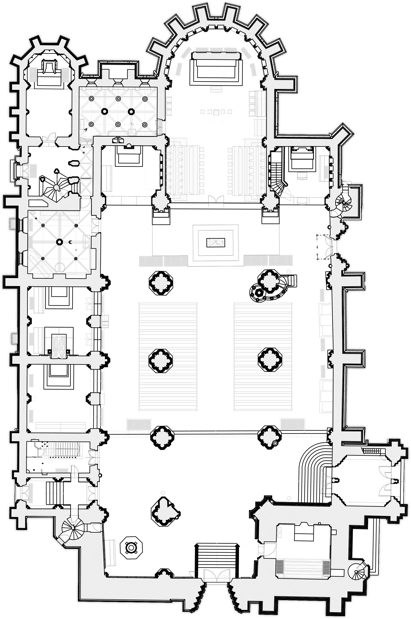
5. Nave
We find ourselves in the central axis of the church with the sacristy in front of us and the main portal—which we saw from the outside—behind us. This area is called the nave, and this is where the congregation sits during Holy Mass. To the right and left are the pews, which seems natural to us, though they didn’t always form part of churches. Churches in the Middle Ages did not have pews in the nave, and worshippers either stood or kneeled during Mass, even turning in the direction required by the liturgy. The side altars and chapels that we will soon take a closer look at played an important part.
The columns supporting the ceiling are adorned with flags. These were used as decorations in the 1896 millennial celebrations, when Hungarians celebrated the one-thousand-year anniversary of arriving to present-day Hungary. The flags represent the various provinces of the Kingdom of Hungary. What we see are copies of the originals.
The former territories of the Kingdom of Hungary appear elsewhere in the church, too: if you turn around, you can see their symbols on the coats of arms under the choir. Other symbols include that of Budapest, which is the fourth from the right. The lower castle symbolizes Buda and the upper castle is Pest, with the Danube dividing the two. At the time of the extensive works performed at the end of the 19th century, the patron of Matthias Church was the capital city of Hungary, which basically means that the city owned the church building. That is why the Budapest coat of arms is located in a number of locations around the church.
If you look to the right, you will see three large windows, which allow sunlight in (if you’re lucky and the sun is out). The naves of medieval churches featured large, ornate windows on their southern fronts but never on the northern.
The beautiful leaded windows were made during the large renovation at the end of the 1800s and luckily survived the ravages of even the Second World War. When Budapest was first bombed, the air pressure broke the windows of the nearby Heart of Jesus Church in Varosmajor. When Béla Kátay, the pastor of Matthias Church, heard this news, he had the windows removed and transported to a safe location. Although the church sustained a number of hits during later battles, we are lucky to be able to see the original windows.
Let’s take a look at what they portray!
All three basically function like “comic strips” that have to be read from the bottom upwards and from left to right. The middle one depicts the life of the Virgin Mary, the one on the left the life of Saint Margaret, and the one on the right the life of Saint Elisabeth. It is interesting to note that both Hungarian princesses are relatives of King Béla IV, who established the Church of the Assumption: Elisabeth was his sister and Margaret his daughter.
The first frame of each story, located in the bottom left corner, shows the birth of the saint, and the last, the top right frame, shows their glorification: Saint Margaret and the Virgin Mary are assumed into heaven and Saint Elisabeth is lifted from her grave.
The designers made good use of the space available to them: although the window featuring the life of Saint Margaret is smaller than the other two because the Bride’s Gate is located underneath it, it still contains a story of 12 frames just like the other, larger windows.
Let’s now take a look at the bottom strip of the leaded glass: Mary’s window depicts a row of the coats of arms of the medieval monarchs who participated in the construction of the church: Béla IV, Louis I, Sigismund, and of course Matthias. The participants of the late 19th century reconstruction works adorn the bottom of the Elisabeth window, with Franz Joseph I and Queen Elisabeth in the middle and the coats of arms of Hungary and Budapest on either side.
Almost every fresco in the Matthias Church’s nave depict our patron saint, the Virgin Mary. If we turn back towards where we entered the church, we see round pictures above the portal and Matthias’s coat of arms, with inscriptions between them. There are similar frescoes on the other side of the choir as well. These are the mysteries recited in a prayer to the Virgin Mary, the Rosary, and their illustrations.
Similarly, the walls between the windows also contain parts of prayers to Mary, and these too are illustrated with frescos. It is interesting to see that the Virgin Mother is not portrayed directly, but as an image within a picture. What’s more, the picture painted by Bertalan Székely is that of an actual painting: a famous Hungarian painting of the miraculous Madonna of Máriapócs.
The northern wall opposite the windows houses larger, more spectacular pictures. The subject of these, too, is Mary, but they depict her as the patron of Hungary: the pictures on the left and in the middle show the Virgin Mother assisting two Hungarian kings, King Stephen I and King Louis I. However, it is the third one that is of most interest to us, as it captures a legend connected with Matthias Church. When Buda Castle fell to the Turks, they destroyed all statues and pictures depicting any people. However, legend has it that the Hungarians managed to wall up a statue of Madonna and hide it from them. When the Christian armies started retaking Buda a century and a half later, the first canon shots destroyed the wall hiding the statue, and the image of the Virgin Mary that suddenly appeared caused great panic among the foreign defenders of the castle, who were unable to hold out for long.
Károly Lotz painted the image of Mary in a very similar, statuesque style both in this painting and the other two. Take a good look at how she looks in these paintings, because we will see this portrayal later, too!
6. Sanctuary
Before us stands the most important part of the church, the sanctuary. This is where the liturgies take place. All church buildings, regardless of their size and beauty, are basically nothing more than extensions of this space. The centuries-old sanctuary of Matthias Church boasts a number of details that we would be unable to find in modern churches.
First of all, the sanctuary faces east, just like in all other churches built in the Middle Ages. Although Matthias Church is the only functioning Catholic Church remaining in Buda Castle, the ruins and remains of all other churches clearly show that they were all oriented to face east, towards the Danube.
The sanctuary features a magnificent altar in the Gothic Revival style, which was also made according to the plans of the church architect Frigyes Schulek. The altar depicts the figure of the church’s patron, the Virgin Mary, and some scenes from her life.
Above her head we again see the Holy Crown, though this time it is a perfect replica of the original. Tradition has it that the crown was sent by the pope to King St. Stephen I in the year 1000. To commemorate the event in 2000, pilgrims took a copy of the crown to the pope, Saint John Paul II, who blessed it. After the pilgrims returned to Budapest, they placed the crown on the altar in Matthias Church.
Pope John Paul II himself also visited this church. A few decades ago, he sat in the very prelate’s chair next to the altar and talked to the gathered seminarists and religious orders. But he was not the only pope to visit the church: Pius XII visited when he was still a cardinal.
The sanctuary also contains other chairs, which also reflect medieval traditions. We will talk of the two places of honor located a bit further back a little later; for now, let’s talk of those that are closer. These are the so-called choir-stalls that line the two sides of the sanctuary, used for seating priests of various ranks during Holy Mass. The candelabras above them are original Zsolnay ceramics, just like the tiles used on the roof. Although they were designed at the end of the 19th century, they look modern enough to be contemporary pieces.
In line with ancient traditions, the sanctuary is separated from the nave with a low barrier called the altar rail. Modern churches no longer use altar rails, and they have been removed from many older churches. Luckily for us, it has been preserved here as a historic monument.
Up until the recent past, priests used to celebrate Holy Mass facing the altar, in the same direction as the congregation. In the latter half of the twentieth century, the ancient Christian tradition of having the priest turned to face the people when celebrating Mass was revived. Churches were redesigned all around the world to reflect this change: altar rails were removed and versus populum altars were set up in sanctuaries. This new altar is like a table, with the priest standing behind it and facing the congregation during the celebration.
To accommodate the changes, a temporary wooden altar was installed in Matthias Church in 1964, which remained in use for half a century. The altar we see today was completed in 2013 to coincide with an extensive renovation of the church. It was carved from limestone based on the designs of the architect Zoltán Deák. Although it is a fresh, contemporary work, its majestic appearance is well aligned with the church’s eight-hundred-year history. The central pillar supporting the table symbolizes Jesus, and the 12 columns, his 12 apostles. The inside of the altar contains relics of Hungarian saints from the time the nation was founded: there are bone pieces of Saint Stephen, Blessed Gisela, Saint Emeric, Saint Gerard, and Saint Adalbert.
The enormous bronze candle holders on either side of the altar are also interesting: if you look closely, you will see that there are four of them, not just two; the other pair are next to the main altar. The originals of these copies are in the Hagia Sophia in Istanbul: they were taken from Buda by Suleiman I, perhaps from this very church. Their copies were placed in the sanctuary in 2006 on occasion of the 320th anniversary of recapturing Buda Castle.
Look up at the ceiling to admire another typical element of Gothic architecture: the exquisite vaults stretching above our heads. It is almost as if the columns next to us were tree trunks and the vaults are their branches. If you look closely, you will see that the parts of the ceiling that have been painted blue form a large cross. With this, Schulek indicated the fact that this part of the ceiling was originally higher up, but the entire ceiling was made the same level sometime during the Middle Ages.
An elegant chandelier is suspended at the point where the building’s longitudinal and transverse axes intersect. Although almost every single minute detail and all the furnishings in Matthias Church preserve the state that Frigyes Schulek dreamed up in the late 1800s, here we see a contemporary piece of industrial art. Since the new versus populum altar was placed in the middle of the church, it required new lighting.
Above it we see the symbols of the four evangelists, who were the first to commit to paper the words and deeds of Jesus. That is what the New Testament contains. The angel represents Matthew, the bull Luke, the eagle John, and the lion Mark. Each holds a book, indicating the four gospels. These four special symbols are commonly used in Catholic art. We will see them in several other locations in the church, for example right next to you.
But before you take your eyes off the ceiling, turn your gaze towards the choir and find the next point, after the chandelier, where the Gothic vaults intersect. There we find a worn yet still resplendent statue of Mary with the Baby Jesus. This is the work of Frigyes Schulek on the basis of a keystone in the original, medieval Matthias Church.
The keystone is the final element that is the last to be laid in place when building an arch or vault; although it is the last piece, it is responsible for holding the entire structure, which would collapse without it. It is no accident that it often figures in metaphors, including as a symbol of Jesus.
Now let’s take a look at the balcony-like structure suspended by a small pillar. This is the pulpit, which used to be an essential part of churches. While the sacrificial celebration took place in the sanctuary, the sermon was given in the nave, so the congregation could hear it better. That is the purpose of the pulpit, which helped better distribute the sound of the priest’s voice in the church back when there was no amplification.
Since this is where the priest read the Word of God, the Gospel, the pulpit parapet is often also decorated with the four evangelists. We can recognize them easily, as the symbols we have seen on the ceiling can be seen at their feet: the angel, the lion, the bull, and the eagle.
Gothic pulpits also often feature four other saints, called the four fathers of the church. Since they too were great teachers and intellectuals, they befit the place where the priest taught the congregation. Similar to the evangelists, their figures are also accompanied by symbols: A lion lies at the feet of Jerome (similarly to Mark); Augustine features a small child emptying the sea with a spoon; Ambrose is depicted with a beehive; and Saint Gregory the Great is shown with a dove.
Opposite the pulpit, between the Bride’s Gate and the sanctuary, is the Chapel of the Holy Cross.
A chapel is actually like a small church in itself, with its own altar and patron saint. Although chapels can stand alone, large and important churches such as Matthias Church have a number of independent chapels. One of these is the Chapel of the Holy Cross.
Its architecture is worthy of note: one side features alcoves, probably preserving memories of the Middle Ages. Frigyes Schulek added alcoves on the other side for the sake of symmetry only, as they cannot be used for sitting because of the steps leading to the crypt.
As we walk back to the main portal beneath the choir, let’s also examine the Gothic Revival confessionals. These resplendent works of carpentry were also based on Schulek’s plans. The doorknob on the outside, to be grasped by the sinful person preparing to make a confession, takes the shape of a snake, while the inside is an angel’s wing, supporting the person leaving the confessional, cleansed of sins.
7. Vestibule
When standing under the choir, we can observe the interior side of the main portal, which is a good illustration of the difference between the thinking of medieval people and the people of today. Namely, what is the difference between the Gothic and the Gothic Revival styles? Medieval churches developed organically over the course of centuries, with an increasing number of details and additions added to the buildings, leading to a result that is irregularly beautiful but sometimes asymmetrical, a fact that did not bother the congregation in the least. However, people at the end of the 19th century desired symmetry, regularity, and perfection, which were considered standards of beauty.
Let’s examine the methods used by the extensive reconstruction of the late 1800s in order to eliminate medieval irregularities. Here we have the main portal, which is not centrally located compared to either the church axis or the arch above it. Bertalan Székely used two angels to provide visual balance. Note that their wings are visible to the same degree, but the wing of one is in front of the banner of text and the other is behind it.
If you take a step back and look at the Gate of the Virgin Mary, through which you entered the church, you will again see that the double doors are not centrally located. Schulek balanced this out using asymmetrical stairs.
An even more eye-catching architectural solution aimed at achieving symmetry can be seen at the rose window located next to the main portal. Since the original small opening was again not located centrally, they cut a new, larger circular window on the interior and then linked the two with a series of circular openings of increasing size. The end result is so surprising that it could even pass as the window of a 20th century or contemporary building.
The peculiar creation is made even more exciting by the fresco: the leaded glass portrays the Lamb of God, from whose feet four springs flow. The fresco continues this motif: the water from the springs flows along the window sills.
The painting next to the rose window at the bottom of Béla Tower commemorates a historic event: in 1456 King Matthias’s father, John Hunyadi managed to lead Hungarian troops to victory against the larger Turkish army to defend the city of Belgrade, which at the time belonged to the Kingdom of Hungary. According to Hungarian tradition, that’s when the pope ordered that bells should toll at noon all across the Christian world. In truth, the papal bull calling for prayer and protection against the Turks had been issued a few weeks prior to the victory, but posterity has linked these two events.
The same is depicted in Károly Lotz’s work, commemorating the events in three paintings. On the left we see the battle itself, with the Christian forces led by Saint John of Capistrano; above it is the papal decision, and to the right is its announcement.
Almost all of the frescos in the church depict the Virgin Mary, who even appears in this historical composition: she is in the background of the painting on the right, on the banner behind the genuflecting John Hunyadi.
The area around the main portal, or narthex, is the oldest part of Matthias Church. Outside the church we already had the chance to see some carved stone pieces from the 1200s next to the main portal, and inside are some even more beautiful remnants of the age. There is a special capital between the main portal and the rose window: it depicts two monks pointing to a book, namely the Bible. This is the oldest Gothic statue that is still in its original location not only in Matthias church, but all of Budapest.
Most stone carvings have suffered so much damage over the centuries that they were taken to museums during the renovations in the late 19th century and were replaced with copies. However, this work of art was walled up relatively early during some earlier renovations, allowing it to weather the centuries unscathed until it was uncovered and restored in the 1800s.
When Schulek recognized that this part of the building was very old, he adjusted the ornamentation of the Béla Tower to the style of the 13th century—as we saw it at the start of our tour. And he applied the same principle inside: the baptismal font is also in the older, Roman style instead of Gothic.
Its position is no accident: on the one hand, it is placed in the axis of the rose window, as if the waters springing from the feet of the Lamb of God were feeding the font, on the other hand, it is by the main portal, in line with medieval traditions. Back then, unbaptized people were not allowed in the church, which also applied to newborns: that is why they used to build baptismal chapels next to churches. Later, this rule was eased up and the baptismal font was permitted in the vestibule.
To the left of the main portal, opposite the painting of the noon bells, is the entrance to the Loreto Chapel under a painting of the Cloaked Madonna. Before we enter, let’s take a look at the columns to the left of the entryway, where we can see faces peering out from among the carved leaves above the holy water font. These are also medieval carvings retained in their original locations, though they are approximately two hundred years younger than the reliefs of the monks pointing at their books. As we read on the coat of arms located next to the entrance, Matthias Tower was completed in 1470, which is probably when these decorations were completed.
Tradition holds that the capitals depict John Hunyadi and his two sons, Matthias and Ladislaus. However, it is unlikely that a proud ruler such as Matthias would have had his own face and those of family members portrayed in such a hidden location.
8. The Loreto Chapel
According to a legend dating back to the Middle Ages, when the Crusaders left the Holy Land, angels carried the house of the Virgin Mary to Dalmatia, then part of the Kingdom of Hungary, and then on to Italy. This fantastic legend has its roots based on reality: the tiny building was transported by the Angeli family, whose name means angel. Today, the house is located in Loreto in Italy, and a basilica has been built over it. Inspired by this example, a number of chapels have been built around Central Europe containing copies of the famous Black Madonna of Our Lady of Loreto. This happened in Matthias Church as well, where a Loreto Chapel was built at the foot of the large tower more than three hundred years ago, when the church was under the care of the Jesuits.
Every element of the chapel is linked to the Virgin Mary and the holy house. The letter ‘M’ appears in several different stylized formats around the walls, symbolizing the name of Mary. Among them are shapes of a fruit and a flower: with its abundance of seeds, the pomegranate is a symbol of the Virgin Mother’s virtues and endless mercy, and the thornless rose symbolizes that she is free of original sin. The painting above the entryway depicts the famous abode itself as it is being carried by angels above the sea, with the Virgin Mary and the Baby Jesus.
The same is depicted on the peak of the altar, albeit in stylized form. The altarpieces portray scenes from the life of the Virgin Mary, with an 18th century copy of the famous Madonna of Loreto in the center. What makes it extra special is that the original medieval work was destroyed by fire in 1921, and so the Loreto statue in Matthias Church is older than the one currently on display in Loreto, Italy.
At the bottom of the altar we can see a veil, with the image of a face on it. When Jesus was carrying the cross, a woman named Veronica approached him to wipe the blood and sweat from His face. The veil miraculously preserved the image of the Redeemer. Interestingly, a number of altars in the Matthias Church’s chapels depict the Veil of Veronica.
Opposite the entryway stands a very endearing old Madonna statue in a niche. According to tradition, this is the statue that was walled up to protect it from the attacking Turkish forces and then became visible again when Buda was freed—to the consternation of the occupying forces. We have already seen a depiction of this event on a fresco in the nave. Oral tradition has preserved some other stories as well: according to one, King Vladislaus II had the statue made when he escaped an assassination attempt. Another says it was carved by a shepherd boy after Mother Mary appeared to him in a dream. A third tells of the statue having bowed its head towards a monastic priest celebrating Mass in the nave when the church was under the care of the Jesuits.
Whatever happened, we can be certain that this statue was made well after the end of the Turkish occupation, sometime in the 1700s, so even if the legends are true, they involve another statue. It should be noted that although the entire statue was made of limestone, the scepter is made of wood and was inserted into her hand afterwards.
Notably, the series of images in the nave that depict the Madonna appearing to Saint Stephen, King Louis I, and the surprised Turks, are all holding this scepter. Now let’s return to these paintings and take a look at the chapels beneath them.
9. Saint Emeric Chapel
The Zichy family, one of the most prominent Hungarian noble families, had a crypt at Matthias Church back in the 18th century, and they donated substantial funds to the reconstruction works of the late 1800s. That is why one of the chapels is dedicated to them. The family’s coat of arms—antlers branching out from a crown with a cross among them—appears on both the altar and the backs of the Gothic Revival pews. Scenes from the life of Saint Francis can be seen above the pews, as the head of the Zichy family at the time was called Francis.
Of the three large frescos, the one on the left is especially worthy of note. It depicts the saint receiving the stigmata, or the wounds of Christ. Traditionally, this is portrayed by connecting with red lines the Redeemer’s wounds of crucifixion to Saint Francis’s body. This is one of the rare scenes where Jesus is shown not in his human body but as a six-winged seraph.
The chapel’s patron saint is Saint Emeric, a Hungarian saint who died at an early age: it is his statue we see in the middle of the altar. Next to him stand Saint Stephen, who founded the Kingdom of Hungary, and his educator, Saint Gerard the bishop.
The predella depicts scenes from the life of Emeric. Although Frigyes Schulek did his best to use the historical Gothic Revival style throughout the church, he was forced to make an exception here. These are the works of the great Romantic artist Mihály Zichy. At the time, he was the court painter to the Russian czar, and sent his aquarelles for Matthias Church from Russia. It was not possible to reject the offers of the benefactor Zichy family, regardless of the style of the paintings. That is how these Romantic paintings ended up on the wings of the altar.
It should be noted that what you see is a true winged altarpiece, which means that the wings can be folded in, just like the doors of a cabinet. This allows certain scenes to be hidden and others to be revealed if, for example, so required by certain Church holidays. Upon closer inspection, you will be able to see the three hinges on either side, used to move the two wings.
10. Holy Trinity Chapel
The greater part of the interior of the next chapel is taken up by a large tomb: here lies King Béla III and his wife Agnes of Antioch. This is special not only because we are familiar with the burial sites of only a few medieval Hungarian royals, but also because, as mentioned earlier, the church was built by the grandson of Béla III, called Béla IV, which means the building did not even exist when the king who lies here passed away.
How did he end up here then?
In the first centuries of the Kingdom of Hungary, the majority of Hungarian kings were buried in Székesfehérvár; however, their tombs were later ravaged, making it very difficult to identify their earthly remains. Luckily, the resting place of King Béla III and his wife was left undisturbed for centuries. The sarcophagus was found in 1848, and the king’s remains were shortly thereafter moved to Matthias Church.
A worthy place of rest was created when the church was rebuilt, financed by none other than the monarch of the time, Franz Joseph I. The tombstone was carved from limestone in the Romanesque Revival style, in line with the style preferred at the time of King Béla III. Every attempt was made to portray the royal couple in a manner that was as lifelike as possible. The carved stone even includes all the objects they found in the tomb, the originals of which are preserved in the Hungarian National Museum, and even the sizes of the statues are the same as the skeletons. The king was 192 cm and his wife was 150 cm tall, just like their statues.
Above them is a castle symbolizing the heavenly Jerusalem, Christ sitting on His throne, the 12 apostles, and the symbols of the four evangelists—which we have already seen during our journey.
Austrian Emperor Franz Joseph I defeated the Hungarian revolution for freedom in 1849, leading many Hungarians to consider him an oppressor. However, two decades later, the two peoples came to the Compromise of 1867 and Franz Joseph was crowned King of Hungary. The creation of this tomb was one of Franz Joseph’s actions intended to bolster the feeling that he too was a worthy and legitimate successor to previous Hungarian kings. The two plaques on the sides serve as testament to this fact: the family tree on the right traces the king’s lineage all the way back to Árpád, the 9th-century head of the confederation of Hungarian tribes, ancestor of Hungarian kings.
Although it receives less attention than the prestigious grave, let’s not forget about the chapel altar, which is also a special work of art. After the Ottoman empire was forced to retreat, there were no furnishings remaining in Matthias Church. That is one of the reasons why the winged altarpiece is so important, dating back to the 1400s, the time of the building’s Gothic golden age. Originally, the altar had been used in a church in the village of Felsőerdőfalva, located in today’s Slovakia, and was presented as a gift to Matthias Church at the time of the extensive reconstruction in the late 1800s. This is now the only object that provides a glimpse into what the interior of the church might have been like during the reign of King Matthias.
The center of the winged altarpiece depicts a contemporary illustration of the Holy Trinity, which may seem unusual to today’s visitors. It is worth noting that the unknown artist used a new trend that was becoming increasingly popular at the time to portray the throne: perspective. The top left of the altar wings shows John the Apostle—almost always portrayed without a beard—with John the Baptist in a fur cloak to the right of him. Below we can see Saint Peter holding the key to the kingdom of heaven and Saint Paul holding a sword.
11. Saint Ladislaus Chapel
The acts of King Saint Ladislaus was a favorite topic among fresco painters in medieval Hungary, which is probably why they decided to portray scenes from his life in the chapel devoted to him when they renovated Matthias Church. The side walls show three scenes from his life: the miraculous conjuring of water at the top, the foundation of Nagyvárad (currently Oradea in Romania) Church to the right, and the Battle of Cserhalom to the left. In the latter, Károly Lotz depicted the most famous episode of the battle. According to legend, a Pecheneg warrior had kidnapped a girl and tried to escape with her after the battle, but Ladislaus caught up with him and beat him in a duel.
The paintings above the altar show the circumstances of his death. Tradition holds that Saint Ladislaus was originally to be buried in Székesfehérvár along with the majority of other medieval Hungarian kings, but the wagon carrying his body started off towards Nagyvárad by itself, where the ruler’s body was laid to rest.
The second painting shows his canonization. When the king’s sarcophagus was opened, certain parts of his remains were found intact, though Lotz’s painting shows his entire body. Next to him stands Kind Béla III, whose grave we just saw, and at whose behest Pope Celestine III canonized Ladislaus. The portraits of the two kings and the pope are above the composition.
The last painting is quite surprising: for quite some time, there was a custom of making a pilgrimage to the tomb of Saint Ladislaus to make an oath. Tradition has it that breaking an oath made at his grave was to invite death.
Before proceeding to the sacristy to the left and then on to the church’s largest chapel, let’s take a closer look at the words above the entryway. These commemorate the 1867 coronation of Franz Joseph I and his wife, Queen Elisabeth, fondly referred to as Sisi by Hungarians. Remember the location of the inscription—we will come back to it later.
12. Saint Stephen Chapel
Matthias Church is a coronation church. During our tour, we have seen that besides the images of our patron saint, the Virgin Mary, we have seen mostly images of Hungarian saints and rulers. We saw the tomb of King Béla III, the coats of arms of King Béla IV (who built the church), King Louis I, King Sigismund, and King Ladislaus, the chapels of Saints Ladislaus and Emeric, and the colorful stained glass windows showcasing the lives of Saints Elisabeth and Margaret. There have also been numerous references to Franz Joseph I, who was crowned here, and Queen Elisabeth. Therefore, it is only natural that they wanted to provide a fitting commemoration to our most important king, Saint Stephen I, the founder of Hungary.
This chapel, rebuilt by Frigyes Schulek in an imposing Gothic Revival style, was originally built in honor of the Garai family. The interior is so grandiose because it was originally meant to house one of the most important relics in Hungary: the Holy Right Hand of Saint Stephen, which has remained intact since his death. However, this plan did not come to fruition: for many years, the Holy Right Hand was kept in the chapel of the Buda Palace, and it is currently on display in St. Stephen’s Basilica in Budapest. The grand chapel was completed regardless, and its decorations clearly reflect the function it was originally meant for: the frescos depict scenes from the life of Saint Stephen and the devotion shown him after his death.
The paintings above the door depict Saint Stephen as a teacher to his son, as the founder of our nation, and as a good Christian. The scenes most frequently associated with the saint are located at the top: here he can be seen offering Hungary to the Virgin Mary.
The side wall paints a picture of Saint Stephen as a warrior, while the other scenes portray his tomb: on one, angels sing above it, another bears witness to a miraculous healing or resurrection that took place in his name, and a third shows the Holy Right Hand, entirely intact, being lifted from the tomb. The king with a halo next to the sarcophagus is Saint Ladislaus.
The leaded windows portray scenes of Hungarian saints and other saints associated with Hungary. We have already encountered most of them in the nave and the chapels, and they are now joined by less frequently depicted individuals, such as our ill-fated king, Blessed Solomon.
Interestingly, the inscriptions on the windows are in keeping with Hungarian traditions and not the official ecclesiastical titles. For example, even though Saint Margaret was canonized only in 1943 and Saint Kinga in 1999, the chapel windows, completed in the late 19th century, use these titles for both these historical personages.
Exiting the chapel, we find ourselves facing an exceptionally richly decorated hexagonal stairwell with a Gothic Revival tracery railing. During the large-scale reconstruction in the late 1800s, the building was redesigned to provide a permanent place for the royal family, in keeping with the title of coronation church. This included a separate entrance and separate stairs. Let’s see where they lead!
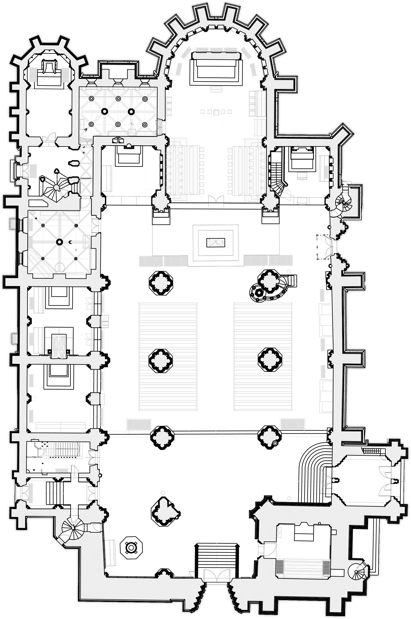
13. The royal oratory
When we arrive at the top of the steps, we turn left to arrive in a special room, with a balcony opening directly into the sanctuary. This is called the royal oratory, where the royal family followed the Holy Mass. If we look for an architectural comparison, it is akin to the proscenium box located directly adjacent the stage in old theatres and opera houses.
Although Matthias Church was rebuilt specifically as a coronation church in the late 19th century, it was actually only used to crown Blessed Charles IV and his wife Zita. The heir to the throne, the four year old Otto von Habsburg, followed the events from this oratory. Although he never had the chance to become king, he did a lot for Hungary in the course of his 98-year-long life as a European politician who spoke perfect Hungarian.
The royal oratory is easily recognizable from outside the building as well when viewed from Fisherman’s Bastion. Statues of Saints Francis and Elisabeth, the patron saints of the royal couple incumbent at the time of construction, Franz Joseph I and Queen Elisabeth, stand between the windows.
The oratory balcony is perfect for viewing the church sanctuary. The choir stalls used by priests during Mass are flanked by two ornate seats, with coats of arms showing who they are intended for. The one on the left is decorated with a crown, antlers, and a cross: this is the coat of arms of the Zichy family, who supported the reconstruction of the church, as we saw in the Saint Emeric Chapel. The other coat of arms is that of the benefactor, namely the city of Budapest, with the coat of arms containing the Holy Crown, a griffin, and a lion.
The sanctuary’s stained glass windows portray the most important saints connected to the church, the city, the nation, and the royal family, most of whom we have already discussed during our tour. However, there are also some who we haven’t yet met. For instance, Saint Francis Xavier is seen on the south wall opposite us, who has ties with Matthias Church not only because he was a Jesuit but also because he is the patron saint of Buda. Saint Martin of Tours, born in Pannonia, is the patron saint of all of Hungary.
The coats of arms of various benefactors are lined up on the leaded glass windows underneath the saints. If you take a closer look, you will see some that are quite interesting. That of the abbot Flóris Rómer has the capital letters BÉKE—meaning peace—surrounded by hearts. The coat of arms of Ferenc Ebenhöch, abbot of Tomaj, is also quite peculiar with its odd wooden contraption rolling across a field. The answer lies in his name, which means siege tower in German.
14. The Chapel of Malta
You may have noticed when you entered the oratory that the top of the royal staircase is covered with coats of arms, which continue into the next room as well. The tradition of hanging the coats of arms of deceased members of the Order of Malta continues to this day. The Hungarian Order of Malta was established in 1928 with the Royal Prince Joseph Habsburg as President, though the Chapel of Malta was already consecrated in the oratory a year earlier.
The fresco is obviously older, it dates to the late 19th century works. Perhaps somewhat surprisingly, it is quite a lifelike depiction of the royal family, at the height of their reign. The Virgin Mary is flanked by the kneeling figures of Franz Joseph I and Queen Elisabeth—fondly known as Sisi—who are accompanied by two figures of the church, János Simor and János Ranolder, who crowned them in 1867.
The painting fits in well with the series of historical frescos in the church nave. The Virgin Mary figures in the center of the painting just like Saint Stephen, King Louis I, or the Madonna appearing from behind the destroyed wall. The series of paintings intends to emphasize that Franz Joseph I, wearing the cloak of the first king of Hungary, Stephen, and bearing the Holy Crown on his head, is a legitimate and worthy successor to the former kings of Hungary.
Although the congregation could only see the fresco from afar and only in part, the inscription on the choir parapet—above the entryway to the sacristy—makes a clear reference to its content.
The chapel’s altarpiece dates to the 18th century. Though we don’t know the artist, we can assume it was commissioned by a Hungarian since it contains a group of Hungarian saints in the lower right hand corner among the people glorifying the Holy Trinity.
A large part of the choir is taken up by the organ reservoir. An instrument was planned to be installed here, in the part of the church with the best acoustics, at the time of the reconstruction in the late 1800s, though the final product was only completed almost a century later, in 1984. If you look past it towards the entrance, you will be able to see the large organ on the other choir. Frigyes Schulek designed the body to harmonize with the Gothic Revival style of the interior. The instrument itself has since been replaced and expanded a number of times. Looking down, you will see the keyboard (or console) on the ground floor next to the entryway to the sacristy. These may seem like three separate instruments, though they in fact form a single instrument: all of the 7771 organ pipes can be played from both the organ choir and the portable console. The smallest pipe is shorter than one centimeter and weighs only 60 grams! The largest, which had to be coiled up to fit inside the church, weighs 175 kilos, is more than ten meters long, and looks like a children’s tool from a playground: it is easily big enough for a child to play hide-and-seek in. This complex instrument is the largest in Budapest and the second largest in Hungary.
Music has always played an important role in the history of the Church of the Assumption: we know even King Matthias had a permanent choir. Franz Liszt debuted his Hungarian Coronation Mass here for the crowning of Franz Joseph I, with the composer listening from the organ choir. It was also the site for the 1936 world premiere of Zoltán Kodály’s Budavári Te Deum, a choral hymn commemorating the 250th anniversary of the Turks having been driven out of Hungary.
Music continues to be a rich feature of life in Matthias Church, with regular performers including Hungarian and guest choirs, organists, and chamber musicians.
We now continue our tour through the Béla Rooms located above the series of chapels, home to museum exhibits. A spiral staircase at the end of the choir will take you back to the base of Béla Tower.
15. Gate of the Virgin Mary
It is now time to say goodbye to the splendid interior of the church and exit the same way we entered, through the Gate of the Virgin Mary. Bertalan Székely painted two frescos for the vestibule, which form a symbolic pair: one depicts the sinful Adam and Eve being cast out of Paradise, the other shows Christ at the gates of Hell, holding the redeemed pair by the hand to lead them to eternal life. Sadly, the originals were destroyed in World War 2, and they had to be repainted based on black and white photographs, which is why the restoration used a grayscale technique.
However, it is not the frescos dating to the late 1800s that are the most interesting, but rather the Gate of the Virgin Mary and the relief from which it received its name. This relief is in fact one of the most important relics of medieval Hungarian architecture and sculpture.
Its fate was far from easy: the Gothic gate was walled up during the course of past centuries, after which a door and a window were cut in the wall. When Frigyes Schulek discovered it at the end of the 19th century, some of the statues had become quite deteriorated, requiring many to be partly or entirely remade. These newer compositions suffered serious damages in World War 2 and required reconstruction yet again, carried out in the 1960s, with the emphasis placed mainly on the original, medieval relics. The latest renovation replaced the old carvings with copies: the original statues are now located in the display to the side.
The composition shows the Assumption of Mary, in a manner that may seem unusual for today’s viewers. Here, the Virgin Mother is not on her deathbed but on her knees, praying with the 12 apostles. Her spirit, taken up into heaven in the form of an infant, appears on the arm of Jesus Christ.
The image is beautiful, touching, just as the fact that a medieval work of art renovated in the 20th century can be seen together with the additions made in the 19th century and their copies from the 21st century. With this work of art symbolizing the span of the church’s eight hundred-year history, we say goodbye and hope to see you again soon in Matthias Church!